The best walks near the East Sussex

June 4, 2026

East Sussex has an underrated walking landscape. Everyone knows the Seven Sisters (and rightly so!) but the countryside immediately around the cabin is good enough that you don't have to drive anywhere to have a proper day out. Ancient footpaths connect the fields, the villages and the pubs in a way that makes almost every walk feel like it was designed to end somewhere worth ending up.


Here are the ones we send guests to most.
From the cabin door


  • To the Six Bells, Chiddingly (1 mile / 20 minutes)

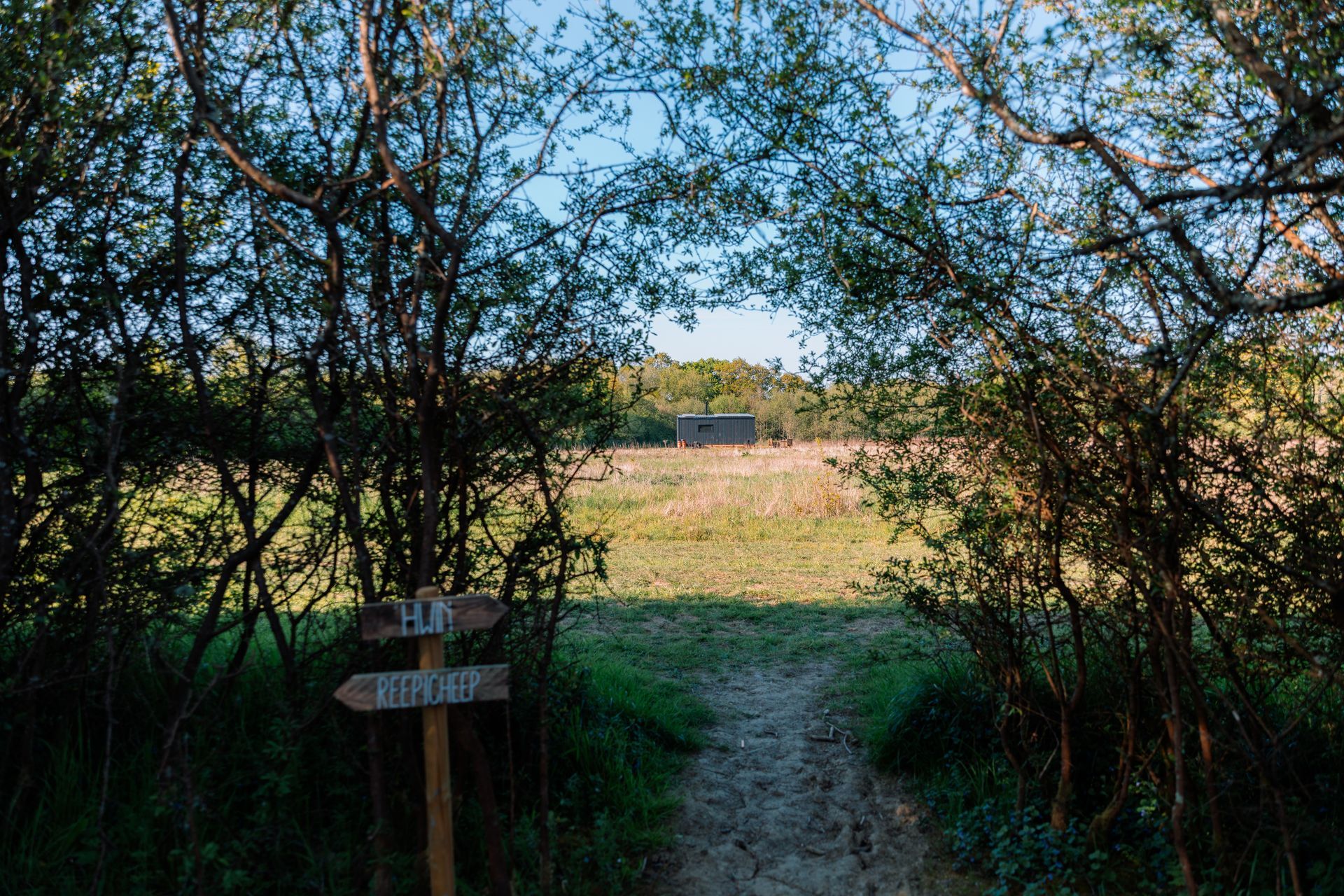
The easiest walk from the cabin and often the most used. Half a mile each way on a footpath through the farm to the Six Bells pub in Chiddingly (we'll share the Komoot when you book). It's flat, it's quick and it ends at a beer garden with live music at weekends. Do it in the evening when the light is low and the fields are quiet.


  • To Gun Brewery and Taproom (8km out and back / about 2.5 hours)

This is the main walk from the cabin and the one worth building a morning around. Head out through the East Sussex countryside on a mix of footpaths and quiet lanes, arriving at the Gun Brewery and Taproom (a working craft brewery with views across the hills). Get a drink, sit in the sun and walk back the same way. The full route is 8km and takes around 2.5 hours at a comfortable pace. Check the brewery opening times before you go and note it's closed Mondays and Tuesdays.


  • Arlington Reservoir loop (19km / about 4.5 hours)

A bigger day out. Park at The Dene near Arlington Reservoir and walk the 19km loop, which takes you through the South Downs National Park with views out towards the coast. Arlington Reservoir is a designated Local Nature Reserve and a good place to see birds — it's a Site of Special Scientific Interest home to a wide range of species. This one takes most of a day so go early, bring lunch and don't leave it for the afternoon.


Worth the drive


  • Beachy Head to Seven Sisters (7km one way / about 2 hours)

30 minutes by car to the south coast, and then one of the best walks in the south of England. Park at the Beachy Head pub and walk the 7km along the clifftops to the Seven Sisters — the series of white chalk cliffs that drop straight into the English Channel. Either catch the bus back from Seaford or walk the full 14km round trip if you've got the legs for it. Go on a weekday if you can; it gets busy at weekends. The views are worth every version of it.


  • Birling Gap and Beachy Head (coastal, flexible distance)

If the full Seven Sisters walk is more than you want, Birling Gap is a good starting point for a shorter coastal walk in either direction. Park at the National Trust car park at BN20 0AB and walk as far as the day allows. Good for dogs, good for any fitness level and the beach access at Birling Gap is one of the few places on this stretch of coast where you can actually get down to the sea.
A note on the local footpaths - The network of footpaths around the cabin is well-maintained and connects most of the surrounding villages and pubs on routes that are walkable year round. Download the Komoot app and follow our profile for the specific routes - we've mapped the main ones from the cabin entrance. Bring wellies or proper walking boots if there's been recent rain as the fields get (very!!) muddy and the paths stay wet longer than you'd expect.
FAQs


What are the best walks near Chiddingly in East Sussex?

The Gun Brewery walk (8km out and back) is the main one from the cabin door. The Arlington Reservoir loop is 19km and takes most of a day. Beachy Head to the Seven Sisters is 30 minutes by car and one of the best coastal walks in the south of England.


Can you walk to a pub from the East Sussex cabin?

Yes. The Six Bells in Chiddingly is half a mile on a footpath from the cabin (about 20 minutes each way). The Gun Brewery is 4km in each direction and also walkable.


Are the East Sussex walks dog friendly?

Yes. All the walks from the cabin are dog friendly. Keep dogs on leads near livestock and between March and July near nesting areas.


How far is it to the Seven Sisters from the East Sussex cabin? About 30 minutes by car. Park at the Beachy Head pub and walk the 7km coastal path to the Seven Sisters. You can catch the bus back or do the 14km round trip.
June 5, 2026
A whitewashed 17th-century inn you can walk to across the fields, the best brunch in Petersfield and a pizza pub 10 minutes from the cabin. Here's where we send our South Downs guests.
June 2, 2026
From the easy 5km loop to the Pub with No Name to the Shoulder of Mutton ridge and the South Downs Way. Here are the walks we recommend to guests staying near Petersfield.
May 29, 2026
Deep Dorset countryside, a thatched pub two minutes from your door and a 9-mile walk to the Cerne Abbas chalk giant. Here's how to spend 48 hours off-grid in Plush, Dorset.
May 26, 2026
Big skies, long footpaths and a whitewashed 17th-century pub you can walk to across the fields. Here's how to spend 48 hours off-grid in the South Downs National Park near Petersfield
May 19, 2026
From the Six Bells beer garden to the Gun Brewery walk and coffee in Lewes. Here are the pubs, cafes and local spots we send our East Sussex cabin guests to.
May 12, 2026
Pubs, bakeries and farm shops we actually send our Cotswolds cabin guests to — from wood-fired pizza at The Stump to cider at Dunkertons and Daylesford for your arrival shop.
May 5, 2026
Rolling East Sussex countryside, a footpath to a local pub and 30 minutes from Beachy Head and the Seven Sisters. Here's exactly how to spend 48 hours based near Chiddingly.
April 8, 2026
Green space, lower cortisol Every one of our cabins sits inside an Area of Outstanding Natural Beauty - Cotswolds, Canterbury, Dorset, East Sussex, South Downs. Studies on green space have linked time in landscapes like these to measurable drops in cortisol, the stress hormone. You don't have to hike or do anything in particular. Step out of the cabin door with a coffee, and the landscape starts its quiet work. Unfamiliar paths, clearer thinking The brain runs most of its day on autopilot (same commute, same rooms, same loops). Moving through unfamiliar terrain is one of the gentlest ways to wake it up again. Our cabins are placed on footpaths you've never walked: Cotswold Way trails from the Andoversford door, woodland tracks in East Sussex, Kent meadows, South Downs chalk ridges. The parasympathetic soundtrack Birdsong and wind through leaves nudge the nervous system into its "rest and digest" state - the one most of us don't spend nearly enough time in. We chose our sites with this in mind: away from roads, away from streetlights, away from the hum of modern life. Guests often tell us they slept better than they have in months. Nowhere to be The brain has a "default mode" it slips into when there's nothing to check and nowhere to be - the background state where memory settles and ideas connect. It doesn't switch on while you're scrolling. Our cabins are genuinely off-grid: patchy signal, no TV, no passive entertainment pulling at your attention. A notebook by the window Journaling in a quiet space has been linked to less rumination and steadier emotions because a thought on a page holds still long enough for you to look at it. Every cabin has a spot for this: a table by a window, a view of the field or the trees. Reading by the wood-burner A University of Sussex study found that reading for just six minutes can meaningfully reduce stress — more than a walk or a cup of tea. Add a wood-burning stove, a soft lamp, and no phone on the side table, and you've got the kind of evening that's hard to describe until you've had one. We built our cabins to be the conditions that let your body remember how to rest.
March 10, 2026
If you ask what the Countryside Code actually says and you'll get a vague answer about closing gates and picking up litter. It's not something anyone really teaches you and the detail has shifted over the years. Its pretty important when you visit the beautiful spots you'll find our cabins in s o here it is in simple words. It's built around three words: Respect. Protect. Enjoy. 1. Respect This is the bit about other people. The farmers, the dog walkers, the family coming the other way on a narrow path - be kind and respectful. Don't block field gates, driveways, or passing places when you're parking. Tractors and emergency vehicles need to get through at all hours. Follow the signs. If a footpath is closed or a sign asks you to detour, there's a reason. Usually livestock, sometimes a fallen tree. Trust it. Leave gates as you find them. Open stays open, closed stays closed. Farmers set gates deliberately and there's almost always a reason. Say hello. A smile and a "morning" to the dog walker coming the other way costs nothing and keeps the countryside feeling like the friendly place it mostly is. 2. Protect Stick to the path. Even when it's muddy and there's a lovely dry strip of grass next to it, stay on the muddy bit. That dry strip is probably growing something, and marked paths exist to keep walkers out of crops and away from nesting birds. Take everything home. Not just the obvious rubbish. Apple cores, orange peel, sandwich crusts. Food waste doesn't biodegrade as fast as people think. It sits around attracting animals that shouldn't be fed. Don't light fires. Open fires in the countryside are almost never allowed, even small ones. Dry grass and heathland catch in seconds. Our fire pits at the cabin are fine because they're contained. Keep dogs close. Between 1 March and 31 July there's a legal requirement on open access land to keep dogs on leads because of nesting birds. Around livestock, leads go on. Leave what you find. Wild flowers, birds' eggs, interesting stones, antlers in the woods. All of it belongs where you found it. Take photos instead. 3. Enjoy The third pillar is the one people forget exists. The Code isn't just a list of things not to do. It's an active encouragement to have a proper time. Plan ahead a little. Check the forecast. Bring the right kit. Tell someone where you're going if it's remote. Download a map offline because phone signal in the places worth walking is famously unreliable. Let yourself actually be there. Put the phone away. Stop and watch the kestrel. Pick blackberries if it's August. Sit on a bench for twenty minutes doing nothing. Have the second pint. Walk slower than you think you should. The whole point of the countryside is that it's not the rest of your life. If you stride through it like you're crossing it off a list, you've missed the thing. Be considerate and leave no trace.
February 18, 2026
Most of us who grew up on The Chronicles of Narnia remember the feeling more than the plot. The hush of the wardrobe door closing behind you. The crunch of snow that shouldn't be there. The sense that you've stepped, by accident, into somewhere the ordinary rules don't apply. That feeling is exactly what we want guests to have when they walk across the field to their cabin. You park the car, close the gate behind you, follow the path through the long grass, and somewhere along the way the week you've just had starts falling off your shoulders. Each cabin is named for a character chosen because something about them felt right for the landscape. Here's who lives where. Dorset Aslan belongs here for the obvious reason. He's the heart of the whole thing: regal, old, quietly powerful, tied to the deep magic of a place. Sit outside with a cup of tea and watch the mist roll off the hills, and you'll understand. Tumnus is his gentler neighbour. The faun with the umbrella who invites Lucy in for tea and sardines by the fire. The welcoming one, the cosy one, the place you come back to after a long walk and feel immediately looked after. Canterbury Lucy is the one who finds Narnia first. The youngest, quietly brave, the one who believes in things before anyone else does. Her cabin has that sense of discovery: pushing through a gate, walking across a field, finding something nobody else has quite noticed yet. Susan is the elder sister. Steadier, more considered. Her cabin is the grounded one, with the most amazing valley views where you find yourself staring for hours. South Downs Jadis is the White Witch, which sounds ominous until you remember her Narnia was buried under endless, beautiful snow. This cabin sits higher and more exposed, and on a frosty morning when the whole valley is silver and your breath hangs in the air, the name makes complete sense. Caspian is the young prince who sails east to find the edge of the world. His cabin has that outward-looking, horizon - seeking feeling. The one where your morning coffee turns into plans for walking further than you meant to . East Sussex Hwin is the mare from The Horse and His Boy. Gentle, thoughtful, quietly wise. Her cabin is the calming one, the place for people who need to be reminded what their own thoughts sound like. Reepicheep is the opposite. The bravest mouse in all of Narnia, forever itching for adventure. This one is for the walkers who can't sit still and want to be out on the footpaths by nine in the morning. Small, mighty, sends you out into the day ready for anything. Cotswolds, Andoversford Cornelius is Caspian's old tutor, the half-dwarf scholar who teaches him the true history of Narnia by candlelight. The bookish cabin. The one you bring a stack of novels to and end up writing in a notebook for the first time in years. Rabadash is the hot-headed prince from The Horse and His Boy. An unusual cabin name until you realise Rabadash is unforgettable. This one has personality. It's the one guests remember. Miraz is Caspian's uncle, a king with a certain commanding presence. The cabin sits well in its field and holds its ground. Cotswolds, Chedworth Bree is the proud war horse from The Horse and His Boy. The showier cabin, the one with the view that makes people stop talking for a minute when they walk in. Aravis is the runaway princess who rides with Bree across the desert. Fierce, independent, stubbornly kind. Her cabin is for the people who came here to do things their own way: solo weekends, girls' trips, anything that starts with "right, I need to get away." Edmund is the Pevensie who goes wrong and then goes right again, and by the end of the books he's the quiet, just one. His cabin has that same steadiness. Forgiving, warm, the one you come to when you need to put a hard week behind you. Tirian is the last king of Narnia. There's a bittersweet quality to him, a sense of an ending that's also a beginning. His cabin sits at the edge of things, where the ordinary world runs out and something quieter takes over.